Euroseeds has published a new position paper on the ongoing revision of Regulation (EU) 2018/848 on organic production, expressing concern over a proposed amendment that would empower the European Commission to establish additional rules for organic plant breeding.
The position paper responds to Amendment 14 adopted by the European Parliament’s Committee on Agriculture and Rural Development (AGRI), which would create a new legal basis for regulating organic plant breeding through future delegated acts. Euroseeds argues that while supporting the further development of organic farming and the supply of high-quality certified organic plant reproductive material (PRM), regulating breeding processes is not the same as ensuring the availability of suitable varieties for organic production.
According to Euroseeds, breeding programmes already deliver varieties with the agronomic performance, disease resistance and local adaptation needed for organic and low-input farming systems. The organisation therefore advocates maintaining a performance-based approach that focuses on how varieties perform in the field, rather than on the specific breeding pathway used to develop them.
The paper highlights several concerns regarding additional breeding-process requirements, including restricted access to genetic resources, higher breeding costs, reduced efficiency and fewer varieties available for multiplication under organic conditions. Euroseeds warns that these measures could ultimately limit farmers’ choice and prolong reliance on derogations where sufficient organic seed is not yet available.
Euroseeds stresses that the main challenge facing the organic sector is not the origin of breeding programmes but the availability of certified organic PRM. The organisation calls on policymakers to focus on improving multiplication capacity, seed quality, market information and the functioning of national organic seed databases to support the continued growth of the organic sector.
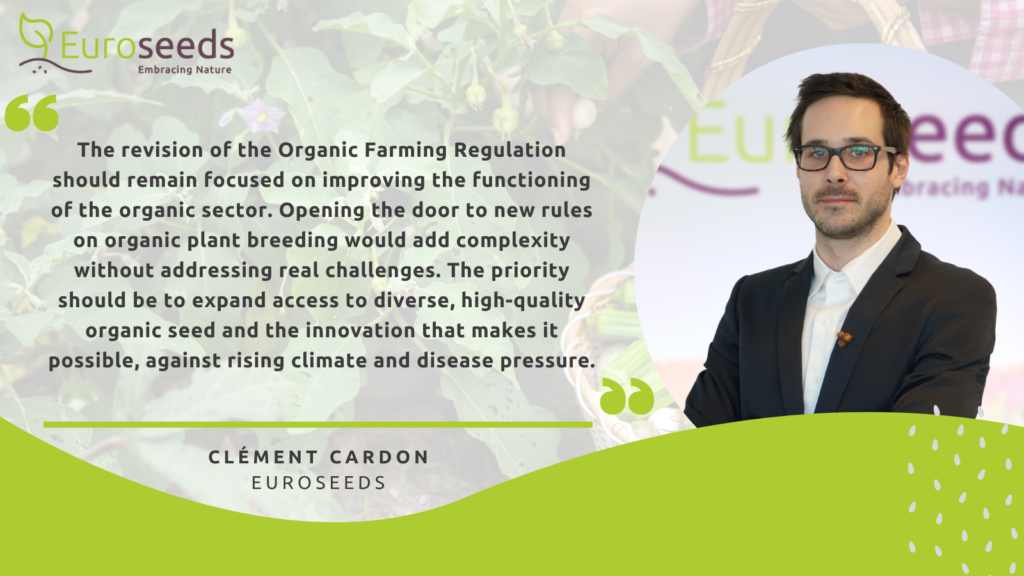
In its recommendations, Euroseeds calls on the European Parliament and the Council to remove Amendment 14, maintain a performance-based approach to variety assessment, prioritise the availability of certified organic PRM, and address any additional market demand through voluntary standards rather than new regulatory requirements.